

What Woke Was
Criticism

There was a time when rainbow-for-a-month corporate logos felt gauche—now, they’re refreshing. There was a time when Pride statements from big corporations felt inauthentic—now, they’re welcome. When it comes to shows of solidarity and belonging from LGBTQ+ allies, silly and easily accomplished performances have become the best I can hope for. But I have to reckon with the fact that on this, the sixth pride month under a trump presidency, things have changed.
One of the most acute changes I feel is limited rhetorical power. In the past, I gave dismissive responses when I heard things like, “It’s fine if you’re gay but why do you need to celebrate it?” or “Why do you get a whole month? Isn’t a week enough?” I’d say something like, “We need to celebrate it until people stop asking why we’re celebrating,” or “We get a whole month because straight people get the other eleven.” I’m no longer comfortable being flippant when I hear conservative complaints about pride.
This essay’s an attempt for me to take stock of my role in this change by providing a cultural history of the epithet given to liberal flippancy: “woke.” Enough time has passed now that I can see that woke wasn’t actually about politics. It was about style. And it fell out of fashion pretty fast.
How We Got Woke
Obama’s 2008 election led to a time when queer people saw many wins, including the repeal of Don’t Ask Don’t Tell, the marriage equality ruling, and a number of transgender inclusion policies.
Obama’s moves for LGBTQ+ progress felt like a response to many years of attacks by both Republican and Democratic politicians.
In the years leading up to his election, I felt the world passively but decidedly move in a liberal inertia. I’d just come out as gay two years prior, during a time when George W. Bush was abysmally unpopular. It was cool to deride conservatism. I watched as a new liberal identity formed. As a gay kid in the mostly-white suburbs of Pittsburgh, this identity had a lot to do with me, but I also felt uncannily distant from it. My classmates began going out of their way to edit their language to respect minorities and scrub derogatory usage from their speech. These were cool things to do. People were dying to show off their willingness to rebel against the stuffiness of Republican parents and corrupt politicians. I was surrounded by, and acted in, many of these performances.
A popular film at the time, The Family Stone (2005), captures this spirit of liberal excitement better than any single story from my own life.
In The Family Stone, Meredith (Sarah Jessica Parker) visits the family of her fiancée, Everett Stone (Dermot Mulroney), who live in a New England town. She’s an inexplicably uptight and anxious woman who is met with great hostility by Everett’s family, which includes his English professor father (Craig T. Nelson), a deeply socially enlightened stoner brother (Luke Wilson), a gay and deaf brother and his partner, and the cool indie younger sister who wears Dinosaur Jr. t-shirts (Rachel McAdams). Also, Diane Keaton is there, as, basically, herself. This household is a socially progressive spectacle.
Meredith, with swift and ferocious force, is rejected by the Stones. Her reasons for being uptight are as mystifying as the family’s reasons for rejecting her—until, of course, the infamous dinner scene.
It turns out, Meredith is homophobic.
Or is she?
It’s confusing.
In this scene, Meredith puts her foot in her mouth when talking about Everett’s gay brother, who is expecting a child soon. Meredith presses them on “nature vs. nurture,” which the family dismisses with jokes. When Meredith worries about the purpose of the “gay gene,” one Stone family member wisecracks, “didn’t they determine it was for window treatments?” Diane Keaton begins a monologue about wishing all three of her sons were gay. Meredith, interrupting, digs herself deeper: “You didn’t really hope for gay children, did you?…for a child to be challenged like that?” This is when the Stones lose their cool: the English Professor slams his fist on the table; Keaton, with teary eye contact, expresses her love for her gay son. Meredith, panicked and flushed, leaves the table and blames her partner, Everett, for not supporting her.
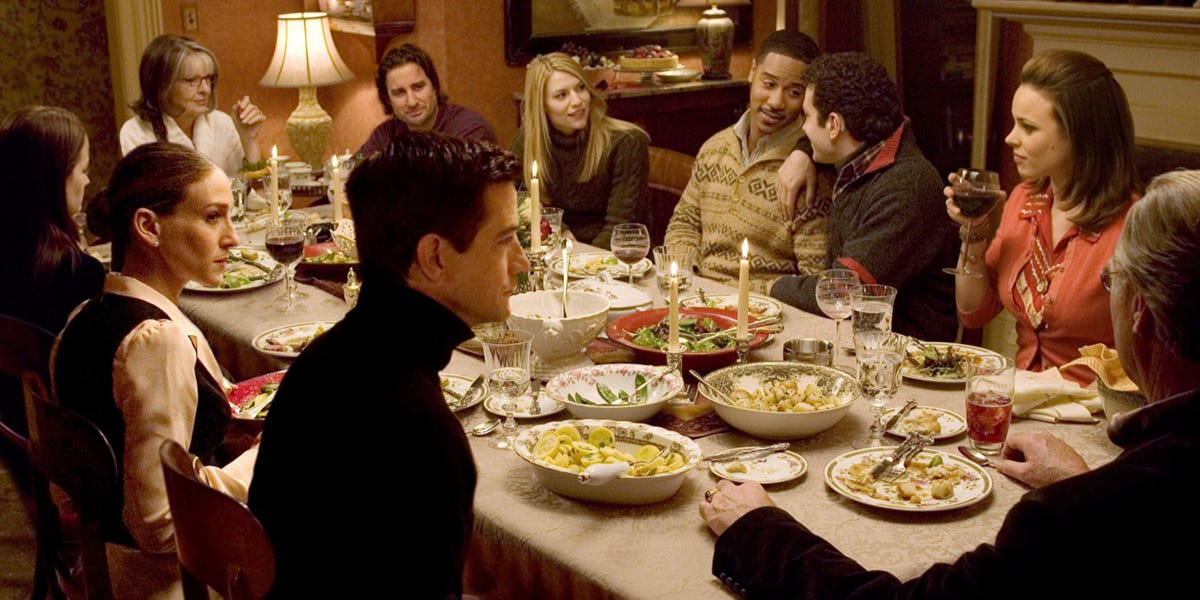
While I won’t go so far as to say I now sympathize with Meredith in this scene, I will say I can’t sympathize with the other characters at the table. While the Stones are making ethical sense—centering attention on the person being attacked, decentering the person who’s causing the pain—the structure of the dialogue has always confused me. The Stones seem to get more angry as Meredith begins to make more sense. Why wouldn’t anyone tell her that she’s not crazy for perceiving gayness as a “challenge?” It is a challenge. The problem with her logic isn’t that being gay is easy—it’s that being gay isn’t a choice.
As Meredith begins to put her foot in her mouth, the Stones quip at her comments. Their quips are framed as gracious, offering Meredith an out that she refuses to take. But Meredith doesn’t speak their language. They’re not being gracious; they’re being exclusive. Then, as the scene builds to the liberal parents’ explosion, the characters make what seems to be fearful eye contact with one another. Meredith is being sacrificed to the liberal God: Diane Keaton. It’s a bloodbath.
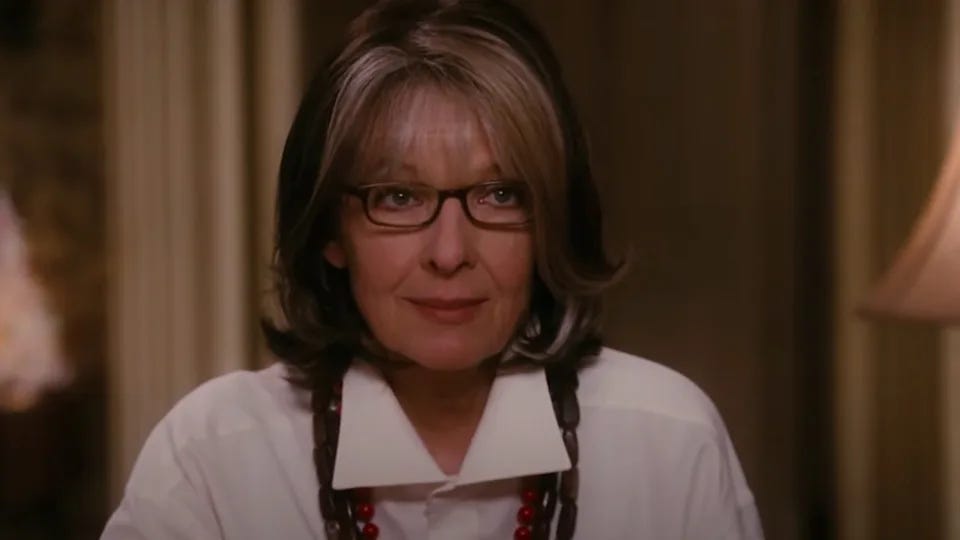
Meredith only needs a little support to understand what the Stones seemed to all seem to unanimously and implicitly understand about being gay. But in refusing to offer support, the Stones imply something perhaps more disturbing than Meredith’s ignorance: the possibility that they themselves don’t understand their own allyship.
What if the Stones are unable, rather than unwilling, to support Meredith’s understanding? It’s not the Stones’ politics that cohere; it’s their sensibility. They like to laugh at the same things: stuffiness, conservatism, uncoolness. Or, put more honestly, they like to bully the same kind of person.
Justice for Meredith…?
Meredith’s sacrifice was a manifestation of liberal power that liberals would later pay for.
The Stones would’ve been thrilled with what happened three years after the film’s release: the election of Barack Obama and a wave of pro-LGBTQ policies. But, how would the Stones have done in the backlash to Obama? The Trump era has been full of horrors, including a slew of anti-trans policy and the overturning of Roe. But throughout all this time, from before Obama until now, in Trump’s second term, a silent, consistent conservative complaint against “woke” has been pumping its quiet heartbeat through political discourse. Liberals emerged as the ultimate bullying authority, which has, according to some, tormented normal Americans and crushed free speech.
If we think of Meredith as the primordial complainant whom leagues of conservative activists rose to defend, it’s worth rethinking what was going on around that dinner table. What unfair satisfaction was gained from roasting a panicked Meredith? Why is the structure of the conversation a crescendo rather than a circle? Which of Meredith’s questions were answerable, and which weren’t?
I don’t personally feel like I need to call the conservatives whose feelings I’ve “hurt” over the past few decades and apologize. But I do wonder if there was an air of self-righteous satisfaction in how I approached interactions with the Merediths in my life. I don’t blame myself if there was. I was a young queer person who was myself terrified about surviving this world. However, if I was at times indignant and smarmy, the depth of today’s political division becomes easier to understand.
Democratic pundits have begun accusing Chuck Schumer—democratic minority Senate leader—of this crime. He infamously asserted, as part of his 2016 political strategy, that “for every blue-collar Democrat we lose in western Pennsylvania, we will pick up two moderate Republicans in the suburbs in Philadelphia.” This attitude—acquiescence to the necessity of sacrificing “deplorables”—is what resulted in the disastrous 2019 democratic presidential primary debates. The crowded stage of ten candidates were forced to performatively out-left each other. It was obvious that their feelings and opinions were more diverse than they let on, and yet we only heard the same message in a bunch of different packages. What were they afraid of?
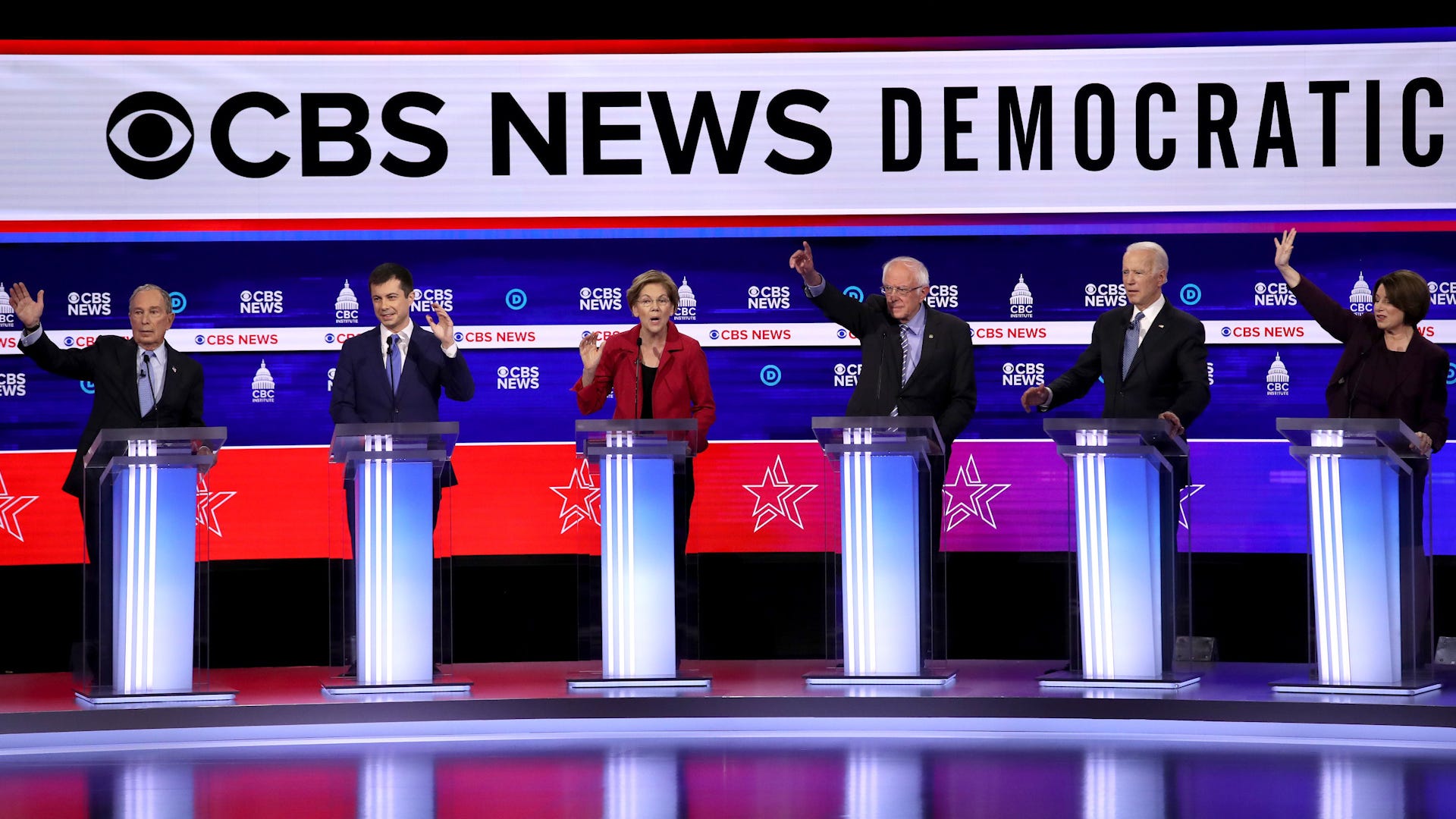
They were still afraid of the wrath of Diane Keaton, fifteen years later. None of them wanted to look like Meredith. But all of those fears were embarrassingly superficial, and we ended up with an absent president who handed the presidency back to Trump. It shouldn’t be this hard to respond honestly to people who needed a bit more support in understanding liberal perspectives. It shouldn’t be this hard to resist the seductive pull of smarmy liberal sensibility.
Am I Part of the Conservative Backslide?
I worry, as I write this, that I’m part of a conservative backslide simply for critiquing liberals. But I’m not critiquing liberal principles; I’m critiquing the sensibility that has made those principles unspeakable and unpopular. No one on that crowded 2019 democratic primary stage was able to convincingly explain progressive ideas such as defunding the police, critical race theory, and opening national borders. They weren’t explaining; they were side-eyeing Rachel McAdams at the dinner table, throwing Meredith under the bus.
Traumatized by what has happened with Biden, democrats have begun prioritizing the “electability” of candidates. But electability doesn’t mean anything. It’s like the word “relatable”—it completely depends on its context. “Electable” just means safe. There’s no such thing as safe. There’s only persuasion and communication.
The true problem with prioritizing electability is that it slackens moral principles. We now see democrats excusing Graham Plattner’s clearly troubling history, or accepting John Fetterman’s voting record simply out of fear of a Republican replacing him. It’s seductive to think “actually I don’t hate cops as much as ICE! So maybe I don’t think we should defund the police?” or “actually I don’t hate militarized borders as much as I hate deportation camps and ICE raids, so maybe I don’t mind building a wall after all.” But these compromises aren’t principled. They’re desperate. And desperation breeds further resentment down the line.
How, then, do we keep our principles, keep the disagreement alive, AND lower the temperature?
I think the starting point is emotional honesty. I need to be able to identify a productive conflict through process of elimination: if I’m feeling attacked, or if I feel like I’m winning rhetorical victory that feels too satisfying, I can pull out.
I recently heard a gay orthodox rabbi speak about political temperature. He argued that, when it comes to homophobia, we need to take the concept of “hate” out of the discourse. If it’s really hatred, get out of there. But if it’s not, and it’s worth talking, then it’s best to assume the root of homophobia is ignorance. Notice, to return once again to Meredith, the signs of anxiety in her body language, and search for patience and compassion. I’m trying, when I can, to search for emotional recognition. The goal is to return to a world in which we can dismiss the fickleness of corporate pride logos, rather than looking back at them with longing.
For more, please see my essay about the infuriating experience of attempting to educate someone who’s long since left the classroom :

I liked this a lot. I think it involves pausing in the space of not knowing and just listening which is hard for us. Because in the pause sometimes the person does say a thing that’s very hurtful too, and doubles down. But I’d rather be in the pause but in the reactivity which ultimately activates me more into unhappiness.
This grew much more complex than I first anticipated. Great essay. My knee-jerk response is that candidates aren't likely to define concepts for which there is no cohesive agreement, defund the police being one. Define it and you lose every voter who doesn't share that definition. It's a no-win situation.
Family Stone is one of those movies I've seen many times, and I love your exploration of the dinner scene. Why the sacrifice? My answer is that it had nothing to do with logic. It's an emotional dam burst that's about the dozen times they've deflected her comments and the indignity of the challenge within the safe haven they've created against a world of such opinions.
But that's just my thoughts.
We're just not as far along as a country as I thought. I suspect that's true for many, no matter how cynical we thought we were. I keep hoping that at the very least people will see the outcome of their choices, and while many have, so many I wish to reach dubious bury their heads in right-wing media, never challenging their beliefs against anything resembling reality.
But that idea that we're not so far along also explains the majority of our liberal politicians who I suspect have been better aware of this than me. They haven't been reflecting our better nature but who we are, where we are. I hate that thought.
I wish we were better.