

Geek Out
Personal Essay

I came out as gay when I was sixteen, but by that point, I was already so immersed in geek culture that the news failed to make me any more untouchable than I’d already been. I was in the anime club; I was a dungeon master; I wore fishnet shirts and impossibly wide black pants to school every day. I’m not sure whether I was drawn to being a geek because it helped mask my gayness, or whether being a geek helped me loosen up, picking the proverbial lock on the door to my closet so that I finally felt safe to come out. In any case, I experienced coming out as gay as the expression of a beautiful venn diagram between geek culture and gay culture.
I’m calling my newsletter “Geek Out,” in part, because of the gay pun. Get it? “Out?” Ha! But there’s a more meaningful explanation. “Geeking out” has always meant indulging in a shared hyper-fixation with someone. It always felt relational, as though, through letting myself love something with someone else, that love could grow in some direction: either toward the thing I was loving or the person with whom I was loving the thing.
Let’s make this a little less abstract.
When I was seven, I had my first sleepover with my soon-to-be best friend, Brad. We’d talked about SEGA Genesis in class and laughed together at the teacher whens she mispronounced it. “Seega? What’s that?”
It seemed like a real connection. I was very excited about the sleepover. What would we do? What did it involve? Would we talk about something new? Would we try new things? Would we stay up too late and sneak around the house? As I imagined the boundless possibilities of the coming night, like a fledgling vampire, I concocted a plan. A scavenger hunt.
I made clues for Brad, drawing little arrows around the house to lead him to the final treasure: a SEGA genesis controller taped up behind the front door. I used almost an entire roll of tape to get it to stick. It looked like a caterpillar nest glued to the underside of a tree branch. I was satisfied with how clever the final location was: he’d never think the scavenger hunt ended where it began: the front door he’d just walked through.
He walked in with his mom, Renee. His duffel bag weighed down his right shoulder. He dipped his shoulder and the bag dropped and rolled. Renee and my mom disappeared into the kitchen to talk.
“Where’s the SEGA? I brought Streets of Rage 2,” he said.
“Wait, I have a game I want to play first.”
“Okay, let’s go.”
“No, the game is here. It’s a puzzle. It starts with this arrow.” I pointed to the wall next to him and an arrow pointing down the hallway.
“Sounds gay,” he said.
“Oh,” I said. “Yeah.”
I agreed, as though some gay outsider made up the game. Not me.
“Yeah let’s go play SEGA,” I said.
I inched beside him and pushed the front door closed. Taped up against the back of the front door was a piece of poster paper with “BARD” scribbled in blue and green marker.
“That’s not how you spell my name,” he said.
“Yeah that was gay!” I said, laughing.
I tore the poster paper off and the SEGA Genesis controller came tumbling out from behind it, onto the floor.
“Cool!” Brad said, crouching to the floor grab the controller. He picked it up and looked around.
“Let’s go downstairs. That’s where the SEGA is.”
We raced to the basement, waving at our moms on the way down.
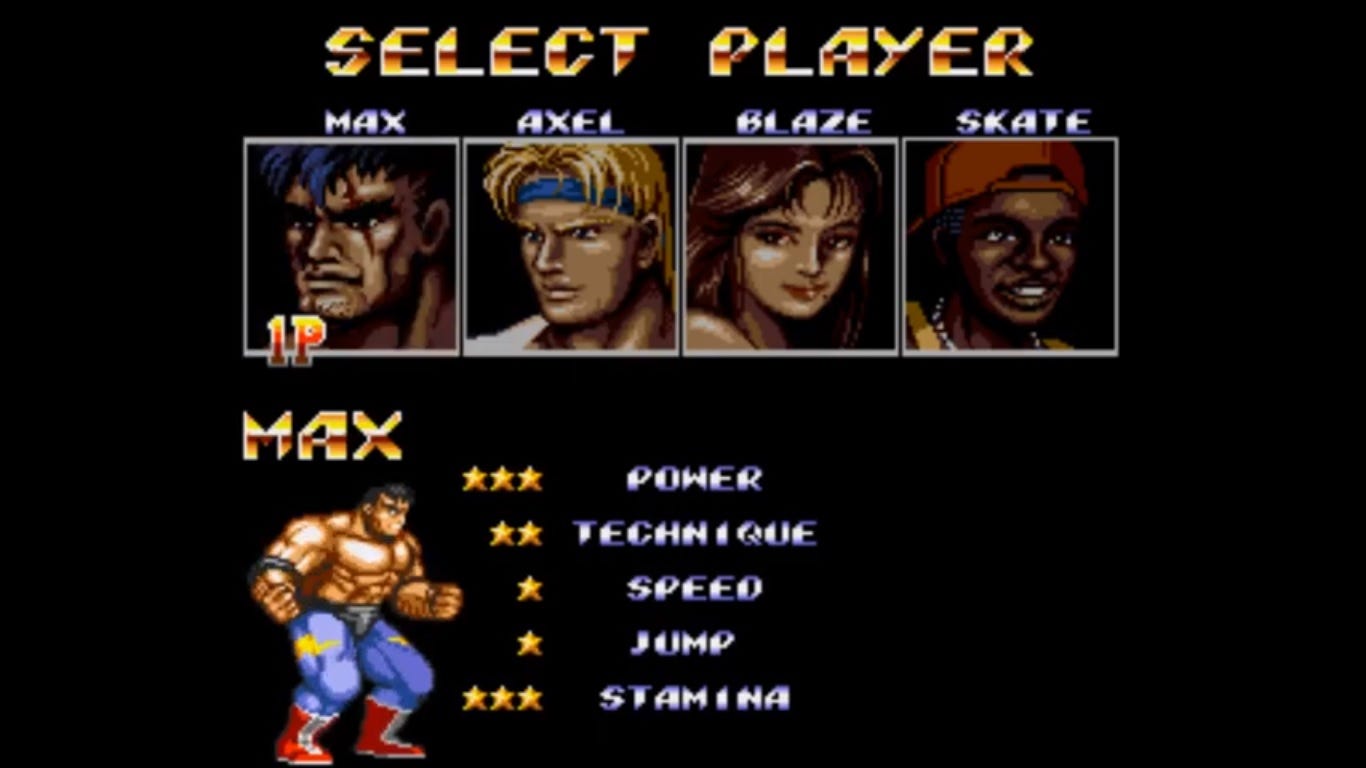
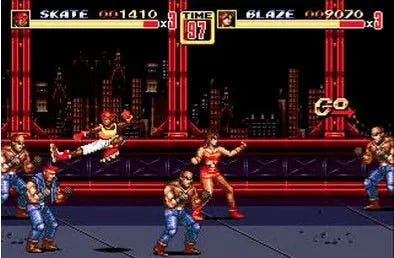
He taught me how to play Streets of Rage 2. I thought it would be a fighting game, like Mortal Kombat, where we try to kill each other with our bare fists. I dreaded it; I was always terrible at competitive games. Instead, it was a cooperative side-scrolling game. We chose out of a menu of four characters—an elite yet eccentric unit of special agents from a NYPD-inspired police force—and, together, took down droves of punks who belonged to a gang that was slowly taking over the city. Brad always chose Max, the brawny ex-professional wrestler. I wanted to choose Blaze, the female leader of the special unit, who wore a cool red skirt and specialized in jump-kicks. However, that might have been gay. So I chose Skate, the child martial arts prodigy who zoomed around the screen on roller blades.
The cooperative challenge confronted us with subtle questions: who would walk ahead to the next screen first? How could we have the other’s back when one of us was low on life? Which was the best character to take on each type of enemy? Every time the “Continue” screen came on, each time we failed, we immediately selected “yes” and chose the same characters again. It was a compulsive mastery process we took on together. Hours flew by.
Brad became my best friend because we loved the same things, and our mutual love for those things grew when we were together. We were catalysts for each other’s fixations.
But he did not become my best friend because I felt safe or loved by him. I felt terrified, in fact. I was gay and he seemed to hate gay things and gay people. And so, he loaned that hatred to me during the time we spent together. I hated gayness, and myself, along with him.
But in spite of our hatred, my love for other things kept growing. And Streets of Rage 2 is still my favorite video game.
I think often about this incommensurable aspect of love. Love seems to want to keep growing in whatever direction it can, which is why, when I couldn't come out, I felt real consolation in getting geeky: becoming a dungeon master, an anime cosplayer, or a vampire wannabe.
I’m living now in the aftermath of it all, of course: I get to love it all. I have it all: a husband, a dog, a Steam Deck to play SEGA Genesis on, and a library of D&D books.
Yet my attention is still unbalanced, intemperate. My consciousness has tendrils wrapped too tightly around geeky things. I get caught, have to turn to them, before continuing to walk forward. Like, for example, an episode of Star Trek that I raved about to my husband last week, and now, to you, dear reader, in which an alien race speaks entirely in idioms. Isn’t that such a beautiful metaphor for why we fail to truly understand each other?
This is extremely relatable to a certain generation of gay boy. Thanks for sharing it.
Darmok and Jalad on the ocean.